

Quanto è probabile assemblare Tron al turno 3?
Matematica e simulazioni per capire le vere probabilità di Tron al turno 3 e il valore di Expedition Map.

Hypergeomancer
Matematico
The current Pauper format is very diverse and cannot be oversimplified to fit a narrative. But it can still be interesting to zoom in on a widespread dynamic, describe it, and discuss how it should affect deckbuilding.
Let's start by looking at the two most popular creatures in the format, according to MtgGoldfish as of today:
| Card | Cost | % of Decks | # Played | |
|---|---|---|---|---|
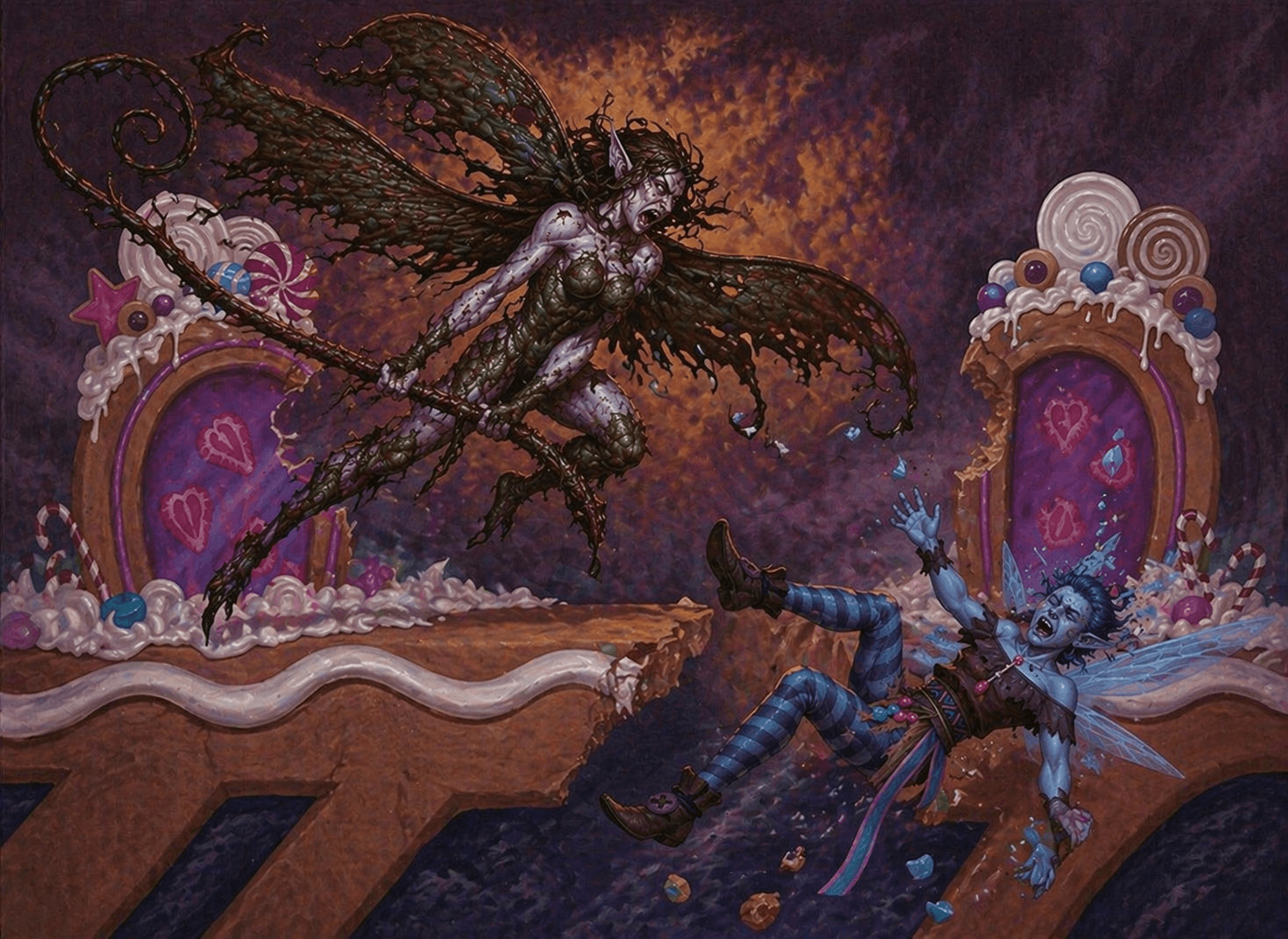
| 1 | Faerie Macabre | 24 | 2.3 | |
| 2 | Sneaky Snacker | 22 | 4 |
After its release, it took a while for Sneaky Snacker to be widely adopted, but it has now established itself as one of the most influential threats in the metagame, due to its popularity and resilience to interaction.
Sneaky Snacker is seeing play in two of the main pillars of the meta: Mono Red and Terror, but it's increasingly spreading to brews, like Naya Gates, Boros Tribe, Boros Moxite, or Mono Red Dredge.
Reactive decks struggle to answer Sneaky Snacker with commonly played interactions, but leaving Sneaky Snacker unanswered spells certain death, as it will eat either life points or other resources every turn. When you ask yourself why a certain reactive deck isn't played anymore, the first thing you should consider is how that deck would beat a T2 Sneaky Snacker. If you can't find a convincing answer, you now know why you don't see the deck around.
So, Sneaky Snacker demands running some specific solutions, which is one of the main reasons for the big uptick in Nihil Spellbomb during the last year. But
Why did I say (2)? Because if a reanimated Sneaky Snacker kills your deck, you need very high chances of preventing it. You can't leave it to chance. Seeing a Sneaky Snacker on the opposite side should be a rare occurrence if you built your deck correctly.
Regarding (1), the most common way to prevent Sneaky Snacker from hitting the board in non-black decks is countermagic. If you manage to counter every rummage effect, Sneaky Snacker won't be a problem. This is one of the main reasons why Hydroblast and Blue Elemental Blast are so popular.
While countermagic is undeniably good against Sneaky Snacker strategies, I think that the Pauper playerbase, me included, might have focused too much on the rummage engine and less on the main payoff. Pre-MH3, I was used to easily beating Rakdos Madness by countering or discarding their rummage spells and destroying their blood tokens. I was trained in that incredibly effective play pattern through years of gameplay. So, when Mono Red Madness came out, I naturally enacted the same strategy, for example, focusing on running discard spells in Jund. How did I change my perspective?
At the last Paupergeddon, the Golden Pigs team decided to bring Elves. While we were preparing for the tournament, GiorgioCombo described to me the plan that I should've enacted against Mono Red Madness: they cannot be allowed to keep a permanent source of damage on the field. Sneaky Snackers must be exiled with Faerie Macabre, and pingers must be killed on sight with Monstrous Emergence and Lignify. While the Elves vs R Madness matchup was broadly considered a lost cause by the playerbase, I ended up facing R Madness four times (+ BR once) at the tournament and beating all of them.
The strategy clicked: their actual engine is their creatures that keep generating free damage. If you keep them away from their creatures, then your lifegain becomes card advantage, as it's supposed to be in a burn matchup.
So, what other options do we have to deal with Sneaky Snacker? We've seen nonblack reactive decks adopt some creative solutions. For example, we saw Torch the Tower in UR Control and Jeskai Ephemerate. Broadly speaking, Campfire and Desert can also be considered solutions to Sneaky Snacker. They're usually adopted by Gardens, but they aren't actually bound to the black color. Anyway, they are pretty mediocre at answering Sneaky Snacker specifically.
There is a card that is available to any deck and deals very well with Sneaky Snacker, and it's the most played creature that I was showing at the beginning: Faerie Macabre. It costs zero mana, it's uncounterable, and it deals with the threat permanently. Its main downside is that when the opponent uses a rummage card and a Sneaky Snacker to draw two cards, and you respond with Faerie Macabre, they keep the same number of cards, while you're down one.
Now, on one hand, if the Sneaky Snacker deck is Madness, you will recoup this resource loss by turning lifegain into card advantage, as I wrote above. If you're facing a different Sneaky Snacker deck, trading down on cards will be more painful, but still very much worth it. Hopefully, Legacy players will forgive me if I bring up Force of Will, but that card is a perfect example to show that when you're facing an incredibly dangerous threat, you can be ok with two-for-oneing yourself to answer it, especially if you're trading up on mana in the exchange. You spent zero mana, while the opponent spent two mana for nothing.
As we saw, Faerie Macabre is already the most played creature. But my suggestion is still for everybody to closely examine their deck and its current answers to Sneaky Snacker, and ask themselves if they could use a few Faerie Macabres to be safer against the Sneaky Snacker menace. Jund Wildfire didn't use to run Faerie Macabre, but I added it a few weeks ago, and it proved to be a great addition to beat the omnipresent Sneaky Snacker decks. Since then, my teammate, seasonofmists, and I have had a lot of success with the same 75.
Since the next B&R announcement is approaching, I want to clarify that the goal of this article is not to "normalize" Sneaky Snacker by suggesting that the format can comfortably handle it thanks to Faerie Macabre. Whenever Pauper reaches a point where Force of Will effects become necessary, it raises legitimate concerns about the health of the format. My aim, however, was to provide useful deckbuilding insight rather than engage in unproductive ban discourse. I'll leave readers to draw their own conclusions on that front.
Riguardo l'autore
Walker735 on Magic Online. Golden Pigs member and Paupergeddon finalist.
Paolo Donfrancesco
Walker735
Altri articoli correlati
Matematica e simulazioni per capire le vere probabilità di Tron al turno 3 e il valore di Expedition Map.
Hypergeomancer
Matematico
Showcase Qualifier Winner
Pietro Bragioto
Scribacchino di liste
Commento al Ban di Seeker
Paolo Donfrancesco
Walker735